
How international experience, entrepreneurial ambition, and practical know-how can help Czech business leaders think bigger and build stronger ecosystems
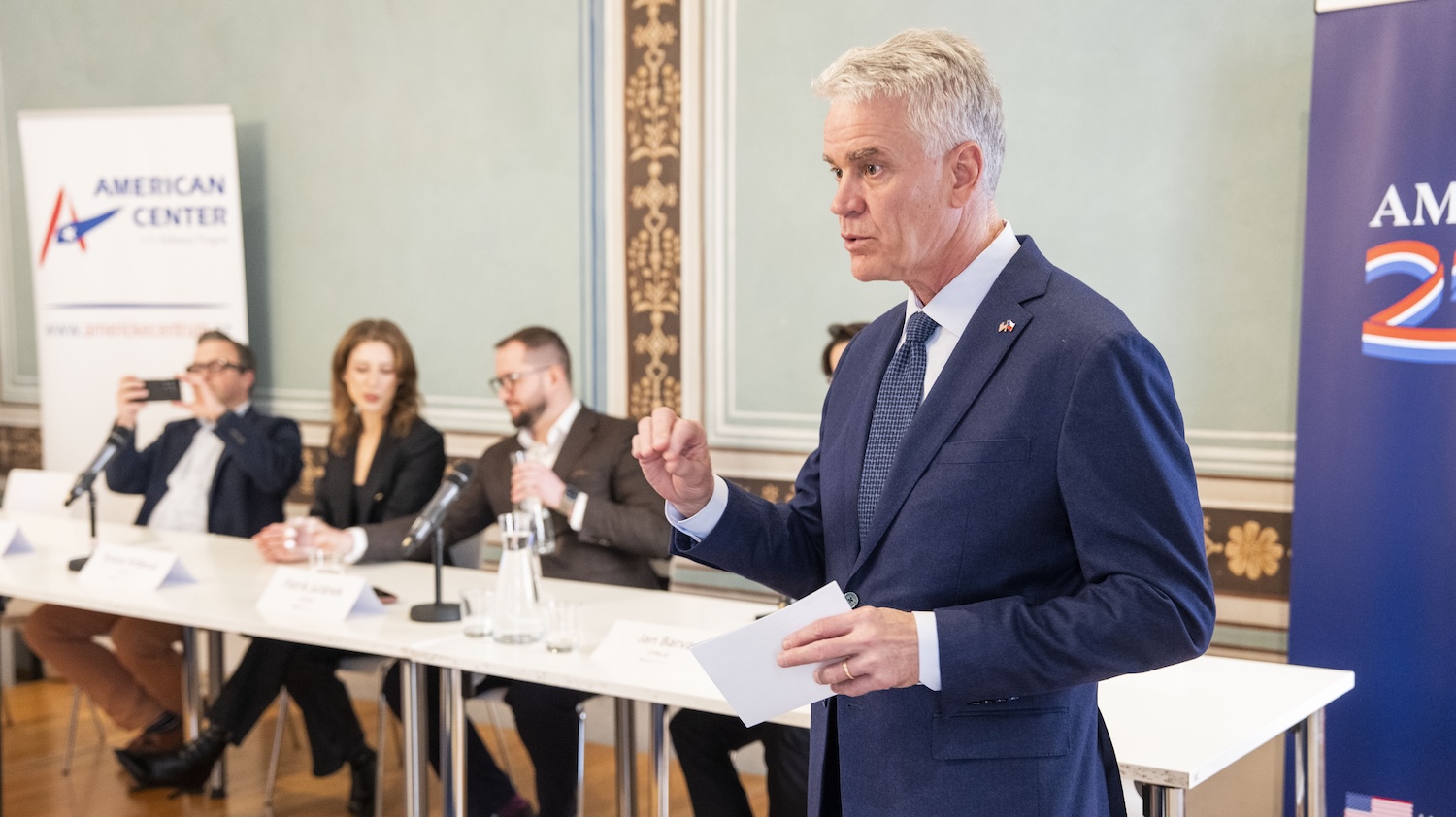
The first edition of the new Business Talks series took place at the American Center in Prague, bringing together entrepreneurs, professionals, public sector voices, and alumni of U.S. exchange programs for an evening focused on one core question:
What can Czech entrepreneurs, institutions, and future leaders realistically learn from the United States — and what does it take to turn that inspiration into real growth at home?
The event was made possible through the support of the U.S. Embassy in the Czech Republic and created a new platform for transatlantic exchange of ideas, practical business insight, and professional networking.
A panel connecting business, startups, academia, and the next generation
The discussion brought together a notably diverse group of panelists: Václav Sochor, Head of Communications at Tipsport; Tereza Hrbková, COO & Co-founder of Citymind; Patrik Juránek, Founder of Startup Disrupt; and Jan Barva, a student at the Faculty of Law of Masaryk University and representative of a younger generation of public-minded leaders. The panel was moderated by Alžběta Králová.
That mix mattered. This was not a narrow startup-only conversation. It was a broader discussion about how international experience translates into entrepreneurship, communication, institutional change, education, and long-term competitiveness.
Ambassador Nicholas Merrick: Czechia has world-class talent, but sells itself too cheaply
A major highlight of the evening was the opening address by U.S. Ambassador to the Czech Republic Nicholas Merrick, who offered a direct and unusually business-focused perspective on the Czech entrepreneurial environment.
His central message was blunt and important:
The Czech Republic has world-class people, skills, and technical capacity — but too often captures only a fraction of the value it creates.
According to Ambassador Merrick, Czechia has something many countries cannot easily replicate: a highly qualified, technically skilled workforce. That is why so many global companies place R&D centers, engineering teams, and advanced operations here. In his view, the real issue is not talent. The issue is that Czech businesses and the broader ecosystem have often been positioned more like suppliers than value owners.
In other words, Czech know-how has too often been sold at wholesale prices, while the larger equity upside, brand value, and long-term economic gains have been captured elsewhere.
That observation hit the core of the evening’s theme. Czechia does not lack capability. It more often lacks scale, confidence, ecosystem depth, and the structures that help entrepreneurs turn high-quality work into high-value companies.
The American difference is not magic. It is ecosystem, ambition, and repetition.
One of the strongest parts of the Ambassador’s remarks was his description of what makes the U.S. startup ecosystem work.
He argued that in the United States, if someone has a promising idea, many of the surrounding building blocks are already available: venture capital, legal and accounting support, talent networks, entrepreneurial know-how, and a culture where sharing best practices is normal. Founders are not solving every problem from zero. They are plugging into an ecosystem that has been built over time by people who figured things out before them.
That matters.
Because in the Czech environment, many of those steps still feel like separate battles. Access to capital, hiring, regulation, legal structure, government support, and international scaling are too often isolated frustrations rather than parts of one functioning growth system.
His framing was one of the strongest takeaways of the evening:
“The source of the frustration is the source of the opportunity.”
That is exactly where many Czech founders, operators, and ecosystem builders are today. The friction is real. But so is the opportunity for those willing to remove it — not only for themselves, but for the next generation.
Different perspectives, one shared theme
What made the panel strong was that each speaker approached the topic from a different angle.
Václav Sochor added a corporate communication and leadership perspective, reflecting on how exposure to U.S. professional culture can strengthen adaptability, clearer communication, and longer-term strategic thinking. Tereza Hrbková brought a startup founder’s lens, focusing on how transatlantic entrepreneurial approaches can be applied in the Czech market. Patrik Juránek emphasized entrepreneurial ecosystem building, cross-border cooperation, and the need to create better conditions for small and medium-sized businesses to scale. Jan Barva broadened the discussion beyond pure business metrics by highlighting civic engagement, education, and the societal foundations of entrepreneurship.
That combination gave the discussion depth. It moved the debate away from clichés about “innovation” and into more useful territory: what kind of mindset, structures, and partnerships actually help a country create more value from its own talent.
Czechia needs more than talent. It needs a stronger ambition infrastructure.
A recurring theme throughout the evening was that Czechia does not primarily suffer from a lack of intelligence or competence. It suffers more from fragmented support systems, lower appetite for scale, and the absence of enough structures that encourage founders and smaller businesses to think beyond survival or modest exits.
One of the sharpest contrasts raised during the event was cultural:
In the Czech context, selling a company for a relatively modest amount may still be seen as a huge success. And objectively, it is. But in the U.S., a founder with similar early traction may be more likely to push for a much larger outcome, raise more aggressively, stay in the game longer, and build with a very different ceiling in mind.
That difference is not about arrogance. It is about default ambition.
And that is where Czech entrepreneurship still has room to grow.
Networking, openness, and the confidence to speak
Another important theme from the discussion was the difference in communication and networking culture.
Several reflections pointed to something simple but powerful: in the American environment, people are often more willing to speak openly, ask questions without fear of looking foolish, and engage with others across different backgrounds, ideologies, and levels of experience.
That does not mean American communication is automatically better. It also has its flaws. But the relative lack of fear in sharing opinions, testing ideas aloud, and building relationships more naturally was repeatedly described as a meaningful advantage.
For Czech founders and professionals, this matters more than it may seem.
In ecosystems, opportunity does not move only through formal structures. It moves through trust, visibility, informal exchange, and repeated interaction. A market where people are more hesitant to speak, ask, challenge, or connect naturally loses speed.
Copying foreign models without context is a mistake
One of the most useful practical points raised in the panel was a warning against shallow imitation.
Too many people, companies, and institutions look at successful foreign products or processes and try to copy what they see on the surface. But they do not examine the context in which those models were created: the market size, investor environment, customer behavior, legal framework, or cultural norms that made them work.
That is a real problem.
Because inspiration without context becomes cosplay.
The lesson is not to reject foreign models. Quite the opposite. The lesson is to study them deeply enough to understand why they work, not just how they look.
AI, education, and the future of practical skills
Artificial intelligence also entered the discussion as part of the broader debate on the future of work, learning, and business readiness.
What emerged was a balanced view: AI can be a useful tool, but much of the hype still runs ahead of practical understanding. The more serious point was that education and professional development should focus less on formal outputs alone and more on the process behind them — discipline, source analysis, critical thinking, judgment, and applied execution.
That is the real moat.
As AI tools improve, the organizations and individuals who will stand out are not those who simply use AI, but those who know how to think, evaluate, adapt, and apply it in real-world contexts.
What this means for Czech SMEs and startups
For Czech small and medium-sized businesses, the evening reinforced a few uncomfortable truths.
The biggest barriers are not just capital or regulation, although both matter. The deeper barriers are often a mix of:
- limited ambition,
- fear of risk,
- weak ecosystem coordination,
- insufficient transfer of know-how,
- and too little practical support for scaling.
There may be willingness in parts of government to support startups, innovation, and digital transformation. But willingness alone is not enough. Policy has to turn into usable structures, usable incentives, and actual simplification.
No one is going to build a strong startup environment by accident.
Why this event mattered
What made this evening valuable was not that everyone agreed. It was that the discussion stayed close to reality.
There was no lazy worship of the American model. There was also no defensive Czech pessimism. Instead, the event created a more honest middle ground:
- the U.S. offers real lessons in ambition, ecosystem design, networking, and scale,
- Czechia has real strengths in technical talent, quality, and capability,
- but without stronger structures, bolder expectations, and more practical coordination, too much value will continue to leak elsewhere.
That is the real strategic issue.
The bigger opportunity ahead
If this first Business Talks event proved anything, it is that Czechia does not need imported mythology. It needs sharper self-confidence, stronger entrepreneurial infrastructure, and more people willing to connect international inspiration with local execution.
That is where the real opportunity lies.
Not in copying the United States.
Not in rejecting it either.
But in learning from what works, adapting it intelligently, and building a version that fits Czech conditions while aiming much higher than before.
For Startup Disrupt, that is exactly the kind of conversation worth amplifying.
Because the future of the Czech business environment will not be shaped only by talent. It will be shaped by whether that talent gets the ambition, tools, networks, and ecosystem support it deserves.


