
From “cookie recipes” to production-grade AI: key takeaways from the Roadshow session in the Czech Republic
AI is everywhere — but most conversations are either hype, fear, or vague predictions. At the Red Hat Roadshow, the tone was different: practical, grounded, and brutally honest about what works, what breaks, and what matters next.
Across the keynote talks and AI panel discussion, a few big themes emerged: open source as a competitive advantage, the real reasons AI fails in production, and why studying IT is still one of the smartest bets — if you approach it the right way.
Below are the highlights from the session.
Open source isn’t charity — it’s a flywheel (Jan Zelený keynote)
A powerful metaphor framed the entire open source discussion: open source is like sharing a recipe.
When a “recipe” is open, other people improve it. They add new ingredients, adapt it to regional preferences, and tailor it for different needs you never predicted. The result isn’t just “free code.” It’s an accelerating flywheel:
- Better outcomes through real-world iteration
- Wider reach because others bring new users and use cases
- Talent access because communities become a long-term hiring pipeline
- Trust and credibility because maintainers build reputations as domain experts
That credibility matters. In open source ecosystems, the people who consistently contribute and lead become trusted voices — and trust converts into business outcomes.
Licenses don’t just protect code — they shape the community
A point many teams underestimate: license choice is community strategy.
Licenses influence:
- who adopts your project,
- who contributes,
- and who can build commercial products on top of it.
Some licenses enforce strong reciprocity (derivatives must remain open). Others are permissive and human (“do what you want; if we meet, buy me a drink”). There isn’t one “best” license — but there is one best fit for your goal.
Takeaway: if you care about the type of community you attract, don’t treat licensing as a legal checkbox.
“If everything is open, how does Red Hat make money?”
This question always comes up — and the answer is refreshingly clear.
Large organizations don’t pay for secrecy. They pay for:
- reliability and support at enterprise scale
- documentation and training
- certifications and compliance (especially in regulated environments)
- and confidence — effectively an “insurance policy” for mission-critical systems
In the enterprise world, “security” often means more than being secure — it also means being able to prove it, certify it, and operationalize it.
AI is failing in production — not because models are bad (Martin Šofer keynote)
One of the most valuable parts of the session was the production reality check:
Many companies build impressive AI prototypes, yet struggle when moving into real operations. The blockers are rarely “the model isn’t smart enough.” The blockers are:
- infrastructure not built for AI workloads at scale
- weak security and governance
- messy data pipelines
- lack of repeatable deployment + monitoring practices
A strong analogy captured it: it’s easy to have ideas “in the lab,” but the hard part is getting the Eiffel Tower to stand on its four legs in the real world.
The AI ecosystem view: Models, Data, Platform
The keynote framed practical AI success around three pillars:
- Models (often fit-for-purpose and increasingly open)
- Data (quality, governance, security)
- Platform (the operational layer: deployment, orchestration, portability)
This is where open models gained a very non-hype argument: smaller open-source models can be deployed where public cloud isn’t an option (critical infrastructure, sovereignty, compliance) and help companies shift from being “token consumers” to becoming internal AI providers.
Panel discussion: AI without buzzwords — speed vs. quality, and what’s next
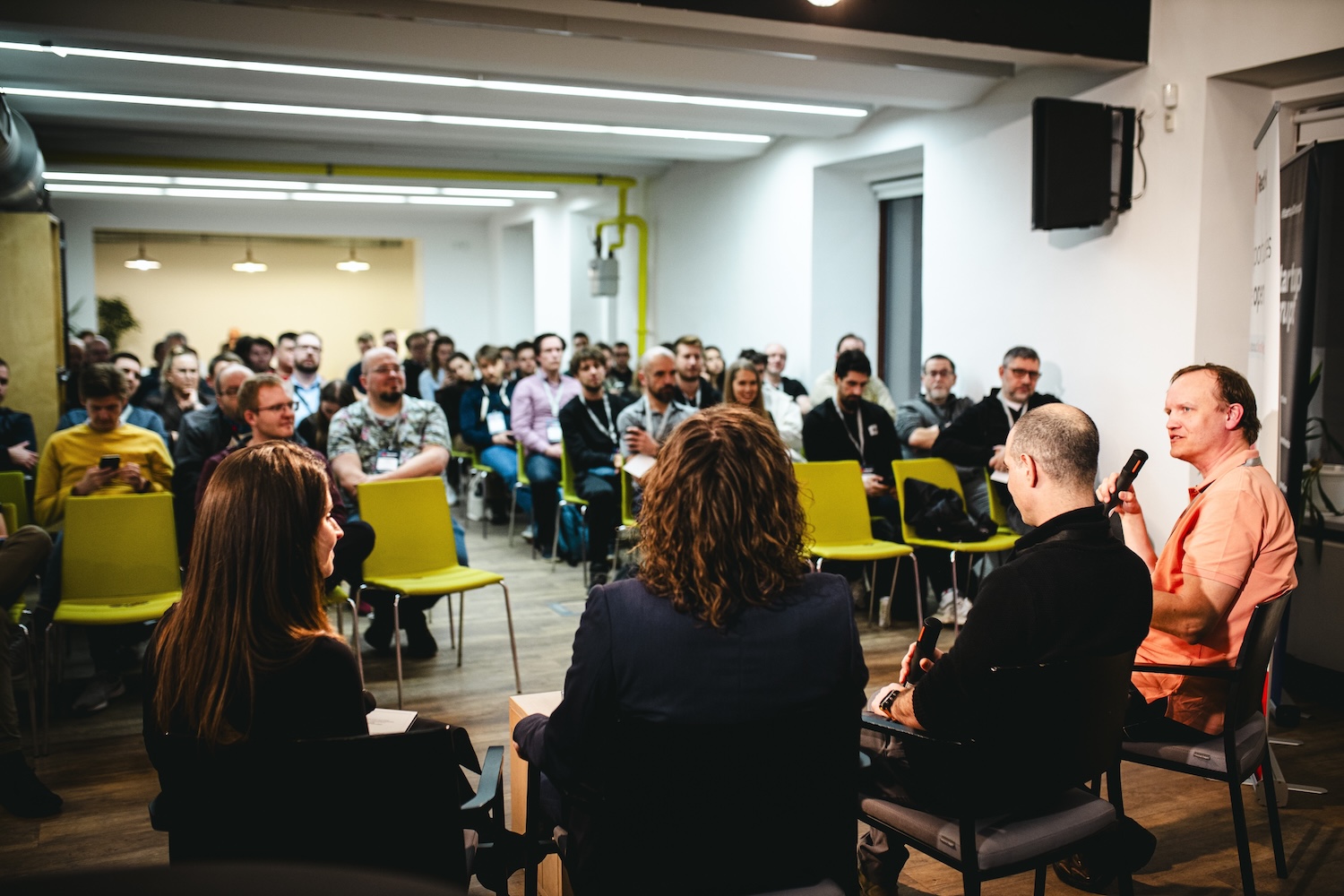
The AI panel, moderated by Michaela Malatín, was the most direct part of the evening. It focused on how AI changes engineering, security, and careers — without pretending the tradeoffs don’t exist.
Quantity vs. quality is the new battleground
AI tooling increases code volume and speed — but can also create fragile systems when teams stop validating what gets shipped.
A key distinction surfaced:
- “deliver code fast” vs.
- “deliver code right”
The riskiest scenario described was familiar: teams generate code quickly, ship it, and later nobody has the time or context to debug it when it breaks. AI didn’t create the failure — lack of engineering discipline did.
Security and vulnerability discovery is changing
A recurring theme: AI can help with vulnerability discovery and analysis, but also increases the volume of code that must be reviewed, tested, and maintained. The result is a higher premium on:
- validation
- observability
- domain knowledge
- and strong engineering culture
Does it still make sense to study IT? Yes — but approach it differently
This question landed hard — and the answers were clear:
- AI is part of IT now.
- The winners won’t be people who “avoid AI,” but those who use it well and validate outcomes.
- Students who experiment, learn fast, and understand fundamentals are not the risk.
- The bigger risk is stagnation: people who refuse to update their workflows.
A practical career strategy also emerged strongly:
Study IT + a second domain.
IT becomes leverage. The second domain becomes context — and context is where real value is created.
Reskilling: arguably the best moment in history
One of the most optimistic takeaways: it may be the best time ever to reskill, because AI tools lower barriers to learning and speed up feedback loops.
But the warning was just as clear:
If your company has chaos, AI can produce automated chaos — faster.
Reskilling succeeds where there is:
- a willingness to change habits
- disciplined validation
- curiosity + responsibility
What stayed with us
The Roadshow didn’t try to “predict the future.” It focused on what’s already true:
- AI will make you faster — but you still own quality
- Open source isn’t just code — it’s a talent engine and a trust engine
- The future belongs to teams who keep learning, keep validating, and keep building in the open
Want to join the next Roadshow?
Red Hat Roadshow is built for engineers, students, architects, researchers, and anyone who wants AI + open source without hype — and with real networking.
Follow Startup Disrupt for upcoming dates and speaker announcements.


