
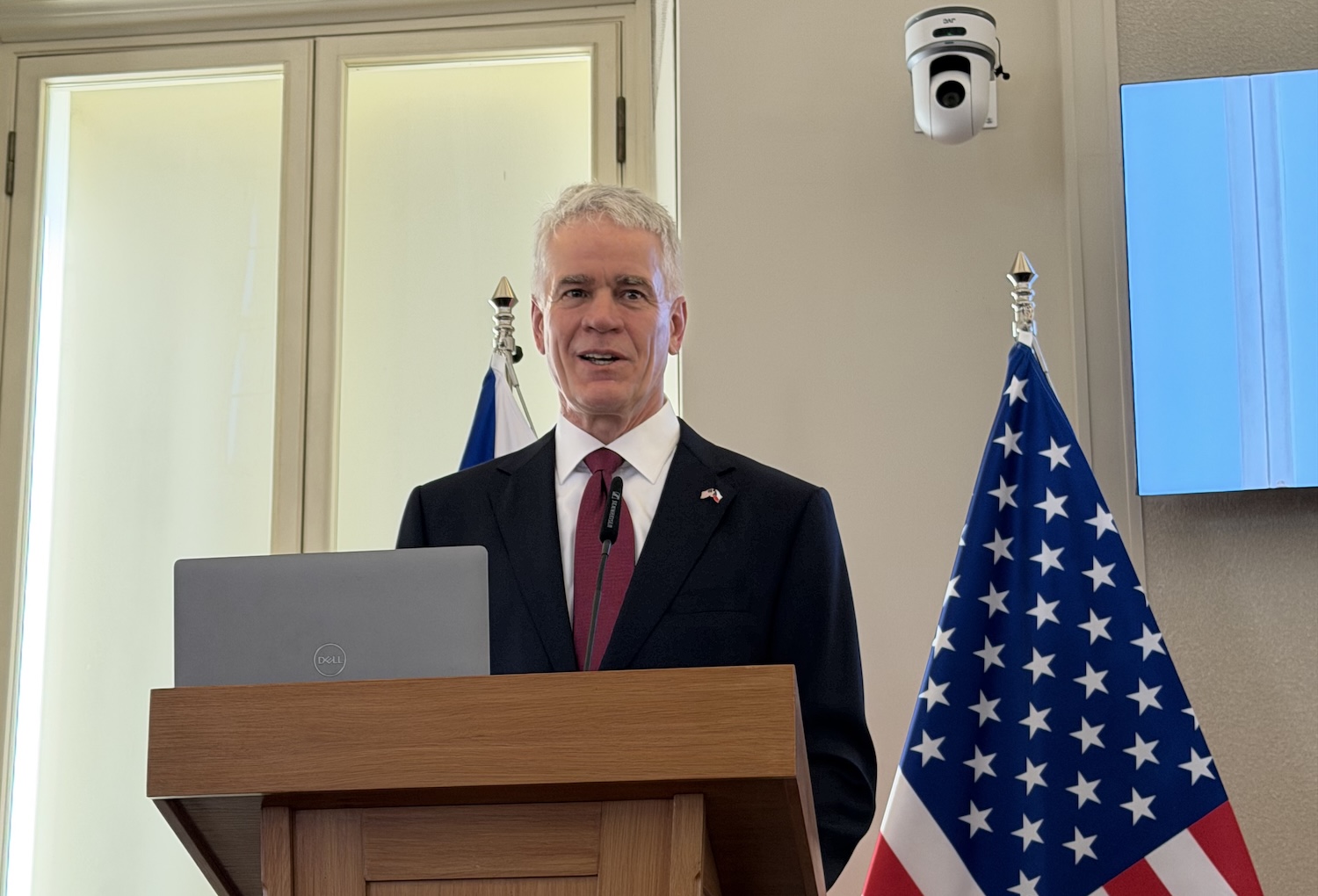
5 takeaways from Černín Palace (March 5, 2026) you can apply immediately
At the SelectUSA “Invest in the United States” conference in Prague, U.S. Ambassador Nicholas Merrick summed up the day with the only metaphor that matters: SelectUSA is “the on-ramp to the highway” into the U.S. market.
If you’re a Czech company thinking about the U.S., here’s what’s actually useful — the parts that prevent expensive mistakes and shorten your timeline.
1) Don’t pick a state. Pick a thesis.
States aren’t products — they’re operating systems. The wrong choice won’t just cost money; it will slow hiring, permitting, logistics, and your first revenue.
Write one sentence:
“We go to the U.S. to ____ (customers / manufacturing / defense contracts / R&D / distribution), and we need ____ (talent, regulatory environment, cost base, speed).”
Then shortlist 2–3 states that match that thesis. The event intentionally showcased very different “fits”: Iowa, Pennsylvania, South Carolina, Texas (East Texas), and Virginia.
2) Incentives are mostly local — and Texas is the extreme version.
One of the most practical points came from the Texas pitch: in many cases, real incentives and permitting momentum are decided locally, not by a distant “state HQ.”
Translation: if you only talk to the “state level,” you can miss where decisions actually happen. Your most valuable early calls are often with local economic development teams.
3) Soft landing beats big bang.
South Carolina’s message was basically: start with a “landing pad,” test, then scale.
This is underrated. A lot of Czech companies go too big too early and lock themselves into:
- the wrong labor market,
- the wrong tax structure,
- the wrong distribution radius.
A 2–5 person U.S. foothold (sales + ops + compliance) is often the highest-ROI move before you commit to a facility.
4) Visa strategy is not admin — it’s a schedule constraint.
The visa session (U.S. Embassy) matters because it sets your earliest possible operating date.
Brutal truth: if you’re serious about U.S. expansion, plan immigration like you plan compliance:
- who travels on what status,
- who must be onshore,
- what your structure enables (or blocks).
If this is fuzzy, your “launch date” is fiction.
5) The U.S. looks familiar — and that’s the trap.
This point was reinforced in the SelectUSA framing and by the finance/legal segments: the U.S. looks similar to Europe on the surface, but key mechanics differ (tax, labor law, liability, contracting, banking expectations).
What you should do:
- choose your U.S. counsel + tax early,
- set up banking and entity structure correctly,
- don’t improvise employment contracts or IP.
“Fixing it later” in the U.S. is expensive.
What you should do next (copy/paste checklist)
If you want a fast, realistic U.S. path:
- Define your thesis (1 sentence).
- Shortlist 2–3 states aligned to it.
- Book 3 calls: one EDO per shortlisted location + one legal/tax advisor.
- Build a landing plan (2–5 people, 90 days) before scaling.
- If timing fits, consider the SelectUSA Investment Summit (May 3–6, 2026, National Harbor, MD) as a high-density meeting point.
Who was in the room (why it matters)
This wasn’t theory. The agenda combined: state EDOs, U.S. Embassy, and Czech investors who’ve done it (PBS Group, Prusa Research, BRANO) — plus finance and legal partners.
That combination is what turns “U.S. expansion” from inspiration into execution.


